The Certification in College Teaching (CCT) is a program offered by the Michigan State University (MSU) Graduate School. Its goal is to prepare graduate students and postdocs for the teaching requirements of academic positions. Through a combination of traditional coursework, professional development workshops, and mentored teaching experiences participants explore what it means to teach at the collegiate level and learn discipline specific best practices. The program culminates in the creation of a teaching portfolio (this website) that can be used during academic job hunts.
Competency 1: Disciplinary Coursework on Teaching
Coursework:
ISE 870 Teaching College Science
Semester Taken:
SS20
Description of the Competency:
The current college landscape assumes if you are an expert in an area (i.e. hold a Ph.D) that you are qualified to teach that subject. This at worst ignores and at best minimizes the large body of work studying how students learn and the resulting best practices. MSU leads the nation, in training the next generation, by offering not just general courses in college teaching but discipline specific courses. As part of the CCT, participants are required to take a discipline specific course on college teaching. In the course, participants learn not only the foundational educational theory but also discipline specific best practices.
Course Summary:
From the syllabus: This course will introduce students to the theory and practice of teaching in higher education, with a specific focus on science. Students will be able to use an understanding of how people learn, the basics of curriculum design, and a range of teaching and assessment strategies and instructional technology to plan for, teach, and analyze effective science teaching. In addition, students will discuss the roles and responsibilities of teaching within the university setting. Abstract concepts will be applied in hands-on activities and research.
Artifact:
Artifact Rationale:
The artifact I chose from the class is the syllabus from the class. It served not only as the course syllabus, but also as an example discussed in class. When we discussed the how to write a syllabus and what information to include we analyzed this syllabus. Since this course I have incorporated aspects like a tentative schedule and non-academic resource sections on my syllabi. Of note, this course was taken during the start of the COVID-19 pandemic. Due to the rapid switch from in-person to online instruction the final portion (March onwards) of the semester did not follow the tentative schedule .
Material Developed for the Course:
Rationale for the Material Developed:
Preparing for an effective class meeting is much more than simply strolling into the room with an idea of what topic you are going to cover that day. This is especially true if the plan is to do more than just lecture to students for the entire period. Knowing how to effectively plan out a lesson and how to make sure that it is aligned with the classes learning objectives is an invaluable skill. As part of the class we had to develop give a 5 minute lesson. As part of that assignment we had to create a lesson plan. This artifact is the lesson plan that I created for the assignment. I chose this lesson plan format because it has a focus on assessment.
Reflection:
This class was helpful in introducing me to some of the basic educational theory, that I was not well versed in. While I had previously stumbled upon some of these concepts, others I had intuited but did not have names for. It was important to be able to name them. It helped me learn how to describe my teaching style. From this class I learned that my teaching style leans towards an evidence-based student-centered teaching style. That has helped me find teaching tools (e.g. the lesson plan format) that fit with my goals. This makes it more likely for me to actually use the tools in my teaching if they fit with my teaching style. I continue to use the lesson plan format when I teach a new course or introduce a new topic.
Competency 2: Creating Effective Learning Environments
Webinar 1:
“I Can Be a Scientist, Too!” How to Create Opportunity in the STEM Classroom
Led by: Jason Love, Davis Tran, Nelson Fuamenya, Ana Munoz, Hina Aftab, Verlese Gaither, and Peter Dorhout
American Chemical Society Webinar Series
2/2/2021
Description of Core Competency:
Many factors go into creating an effective learning environment, from the physical space where the class is held to the policies describing how the class is governed. Addressing the physical space available can require years of planning in the sciences, as efforts to update or create lab spaces are significant monetary investments. To insure that the physical spaces are adequate, instructors should be active in the design process, by serving on university committees related to infrastructure and planning. Additionally, soliciting input from a variety of stakeholders is important to make sure that spaces are functional for everyone. Instructors have more influence on the non-physical environment. They are tasked with choosing the material, method of delivery, and instructional techniques needed to achieve the courses learning objectives. More and more frequently instructors are making an effort to examine how their classroom policies effect students’ sense of belonging. This is an important step in increasing diversity, equity, and inclusion in the sciences.
Artifacts:
Material Developed:
Artifact/Developed Material Rationale:
The first artifact is the slide deck from the “I Can Be a Scientist, Too!” How to Create Opportunity in the STEM Classroom webinar. One of the better aspects of this webinar was that it went beyond just providing the definition for the terms they were going to discuss. Included were some responses to common misconceptions about terms like equity (slide 19).
There are two big strategies highlighted in the seminar that I have adapted or plan to adapt in my classes. One that I have implemented is to incorporate real world examples related to student interests. For example in Organic Chemistry when we are discussing how pH can effect solubility I relate the importance to administering drugs (see slide above) as the course is usually predominately populated by pre-health majors. Because the student population can vary greatly from semester to semester, I like to poll students about what their interests are at the beginning of the semester so that I can find topics where chemistry and their interests intersect.
The strategy I plan to implement is to use class building techniques, where as a class we build class expectations together. Part of what piqued my interest in this technique is the lack of student participation with office hours. During FS21 in a 200+ student course I had >10 instances of students attending office hours. In evaluations students mentioned how the modality of office hours (over zoom) was not their preferred modality. If I had involved students when scheduling office hours there would likely have been student interactions.
Reflection:
Overall creating effective learning environments requires professors to be active across the entire university, from serving on infrastructure and planning committees to actively engaging in community building inside the classroom. To aid in academic equity I have incorporated my students diverse interests into my courses. I plan on including students in the development of classroom norms when feasible and communicating clear and high expectations when needed. These efforts are aimed at making a diverse student population feel welcome and safe, so that they can focus and succeed in chemistry.
Competency 3: Incorporating Technology in your Teaching
Course audited:
Basics of Online Learning and Teaching
Instructors: Sarah Silverman, Paula Kavathas, and Peggy Semingson
Center for the Integration of Research, Teaching, and Learning (CIRTL)
6/2/2020 – 8/18/2020
Description of Core Competency:
There are many ways to think about incorporating technology into the classroom. This goes beyond the staples like powerpoints from lecture slides. To maximize the effectiveness of incorporating various technologies into the classroom, they should be deliberately incorporated during course design. This is especially important post-pandemic where there is likely to be a sustained increase in different course modalities (e.g. in-person, hybrid, online synchronous, online asynchronous), as what works well in one modality may not be as effective in another.
Artifact/Material Developed:
Artifact/Material Rationale:
In this 12-week course we spent the first portion of the course learning about evidence-based approaches for teaching online, including but not limited to selection of learning technologies, fostering online learning communities, different types of online instruction, and learning-through-diversity. To gain experience using multiple platforms the class met on both Zoom and Blackboard, while course material was posted on Moodle. Discussion also included other platforms such as Microsoft teams, D2L, and Google classroom. The second part of the course was development of a course or module for an online course. The project pulled together all of the techniques and practices covered in the first part of the class.
For the final project, we were tasked with developing an activity for an online course we would like to teach someday. As part of the assignment, we had to complete five sections; course information, profile of learners, content planning, feedback and assessment, and activity planning. It touched upon most of the topics covered in the class and culminated in a short presentation to the class. Above are the products of the project along with the instructions.
I chose to work on developing a portion of an upper-level elective I am interested in teaching. The first artifact contains the assignment’s instructions including guiding questions about the incorporation of technology into the class. At the end of the project we had a course outline and the rough outline of a course that we presented (ICSG presentation). Creating a new course from scratch can be a daunting process so the guiding questions are helpful in incorporating technology thoughtfully into the course design. My plan is to utilize this outline and tool to further develop the entire course.
Reflection:
This course highlighted the differences between teaching online and in-person. To effectively teach online it is not simply enough to just record the lectures and post them online. There are different best practices to incorporate depending on whether the course is synchronous, asynchronous, or a hybrid.
One consideration is the population of students you are supposed to teach. They do not all come from the same technological or economic backgrounds. As a best practice, when selecting which learning software to use cost should be taken into account. It is then a balancing act between cost, usability, and simplicity. If the technology is too expensive it will prevent the full participation by those from poorer economic backgrounds. On the other hand, you get what you pay for. Going too cheap may result in a technology being unreliable or poorly design. If the students are frustrated by the technology, they will not be able to focus on the material. The same goes for simplicity. Too many options or gadgets cause students to spend too much mental energy learning the technology instead of the important concepts. As with everything in life, selecting the appropriate educational technologies is a balancing act. In my classrooms I like to use the online homework platform BeSocratic because it strikes a good balance between these concerns.
Another consideration is development of a learning community. In-person courses automatically foster community, as the participants are physically brought together. With online courses, participants can be located anywhere and may not even be interacting with the material at the same time in the case of asynchronous courses. As such deliberate attempts need to be made to build a learning community. Best practices can include moderated discussion boards or a synchronous get to know you session/assignment, at the beginning of the semester.
Competency 4: Understanding the University Context
Webinar:
Navigating a Dual Career Search: The Administrator’s Perspective
Led by: Erika J. Henderson, Joan S. Grigus, and Brenda Kelly
Higher Education Recruitment Consortium
7/12/2019
Description of the Core Competency:
The university context encompasses the academic and non-academic features that make the university a relatively unique social and learning environment. While the previous competencies overlap and require knowledge about the academic context (ex. relevant learning models, student and instructor expectations, etc.), the societal and business contexts are less often considered or covered. Professors interact heavily with these context, through their service to the university, but they are generally overlooked during Ph.D training.
Artifact:
Navigating a Dual Career Search: The Administrator’s Perspective
Artifact Rational:
This artifact is a link to a recording of the webinar. While it was interesting to hear how major universities such as Princeton and University of Houston handle dual career situations, the most interesting was how Gustavus Adolphus College handles the problem/opportunity. As a small liberal arts college in rural MN, they do not have the resources of larger universities. It was encouraging to hear that they have developed networks with other similar universities in the area to aid in dual hire situations. All of the panelists gave the same top two pieces of advice. Try to avoid bringing up you are dual career until after an offer is received and to be flexible.
Material Developed:
Material Rationale:
Although this webinar does not directly relate to classroom instruction, it was the inspiration for a document I will make available on future course websites. Gustavus’s development of a support network for dual-hires, reminds me that students need those social networks to access non-academic resources. I made a list of resources for students in Morris, MN and the surrounding area. College is one of the first times many students are on their own. At small rural schools, like the University of Minnesota-Morris (UMM), where there are fewer resources, students may not be familiar with were to look. To support them and their social growth I cultivated a list of resources (mental and physical healthcare, food, transportation, etc.). I do not claim to be authority on local resources, so the plan is to use this as a living document where students can add resources that they know of to the list. Thus, creating an extended network that students can tap into for social supports
Reflection:
The advice above was very helpful during my search for the next appointment. At two small liberal arts colleges my wife and I were able to negotiate positions for both of us even if they were not the type of position/role we were expecting. Outside of the hiring process, the advice to be flexible is likely to be helpful as professors wear many hats in the modern university, such as teaching, service to the college or extended community, research, etc.
Competency 5: Mentored Teaching Project
Faculty Mentor:
Dr. Melanie M. Cooper
Course Context:
Organic Chemistry Laboratory (CEM 255)
Mentored Teaching Project Worksheet:
Mentor Support Document:
Incorporation of Green and Sustainable Chemistry in Undergraduate Organic Chemistry Lab Experiences
Introduction:
Green and sustainable chemistry (GSC) is a growing sub-field of chemistry, that touches on every aspect of chemistry. As climate change and efforts to limit the effects of climate change intensifies the importance of incorporating GSC principles into chemistry curriculum will continue to grow. This is evidenced by the commitments from organizations such as the American Chemical Society, the Green Chemistry Institute, Beyond Benign, and the United Nations to improve societal awareness and knowledge of GSC principles.
One of the concerns with incorporation of GSC principles into the curriculum is their cross-disciplinary nature. Effective use of GSC tools and principles requires expert level understanding of chemistry core ideas. One-approach that has been implemented is to use a complex tool (i.e. life-cycle analysis or systems thinking) to introduce the core chemical ideas. This approach can be thought of as Complex->Foundational. In Complex->Foundational approaches, an instructor starts with a system like the nitrogen cycle and covers topics like the ideal gas law when discussing the release of N2 gas by burning fossil fuels, oxidation/reduction by soil bacteria, or pH when discussing fertilizer run-off into waterways. The theory is that students learn these core ideas in a way that is grounded in real world examples. There is a lack of evidence to support this approach and a potential problem is that students may not have the framework to know what knowledge or content is generalizable outside of the specific context.
In contrast we lean towards what could be called a Foundational->Complex approach. In this approach students are exposed to chemistry core ideas in order to build a strong foundation and complexity is scaffolded in as the course advances. We utilize this approach because the underlying chemistry core ideas do not change when one approaches a chemical problem from a GSC perspective.
As part of a larger curriculum redesign at a large public land grant university in the Midwest, we have developed a series of case studies designed to introduce GSC tools and principles in a scaffolded manner. Our goal was to introduce GSC thinking to students on a scale they are familiar with (synthetic scheme analysis) and scaffold up to more complex GSC tools (life-cycle analysis and systems thinking). With the idea that as students gained familiarity with applying GSC thinking they could expand their considerations outside of the direct problem/solution and include consideration of knock-on effects.
Previous work on evaluating student’s evaluation of knock-on effects showed that exposure to a life-cycle analysis activity increased students ability to discuss and evaluate knock-on effects1. Unfortunately it did not examine how students pre-existing chemical knowledge affect their discussion and evaluation of knock-on effects. Our work looks to evaluate if there is a relationship between students’ chemistry core knowledge and their ability to apply it to problems through a GSC-lens focusing on knock-on effects.
Teaching as Research Question:
How do case studies elicit student knowledge of chemical core ideas and connect them to practice (the design and evaluation of solutions)?
Objectives:
- Describe the ability of students to explain mechanisms through core chemical ideas
- Quantify the frequency students articulate repercussions or conflict between U.N Sustainable Development Goals (SDGs) and the proposed solutions.
- Evaluate the relationship between mechanistic explanations and students’ incorporation of knock-on effects (SDGs).
Hypothesis:
Students with better understanding of core chemistry ideas will be able to engage more with knock-on effects of the proposed solutions.
Methods:
All data was collected from Organic Chemistry Laboratory (CEM255) during the SS22. At the beginning of the semester students were assigned to groups of 3-4 students using CATME. Students worked in these teams for the entire semester in both the wet lab sections and recitation sections. Groups completed multi-week case studies using the online homework platform BeSocratic2.
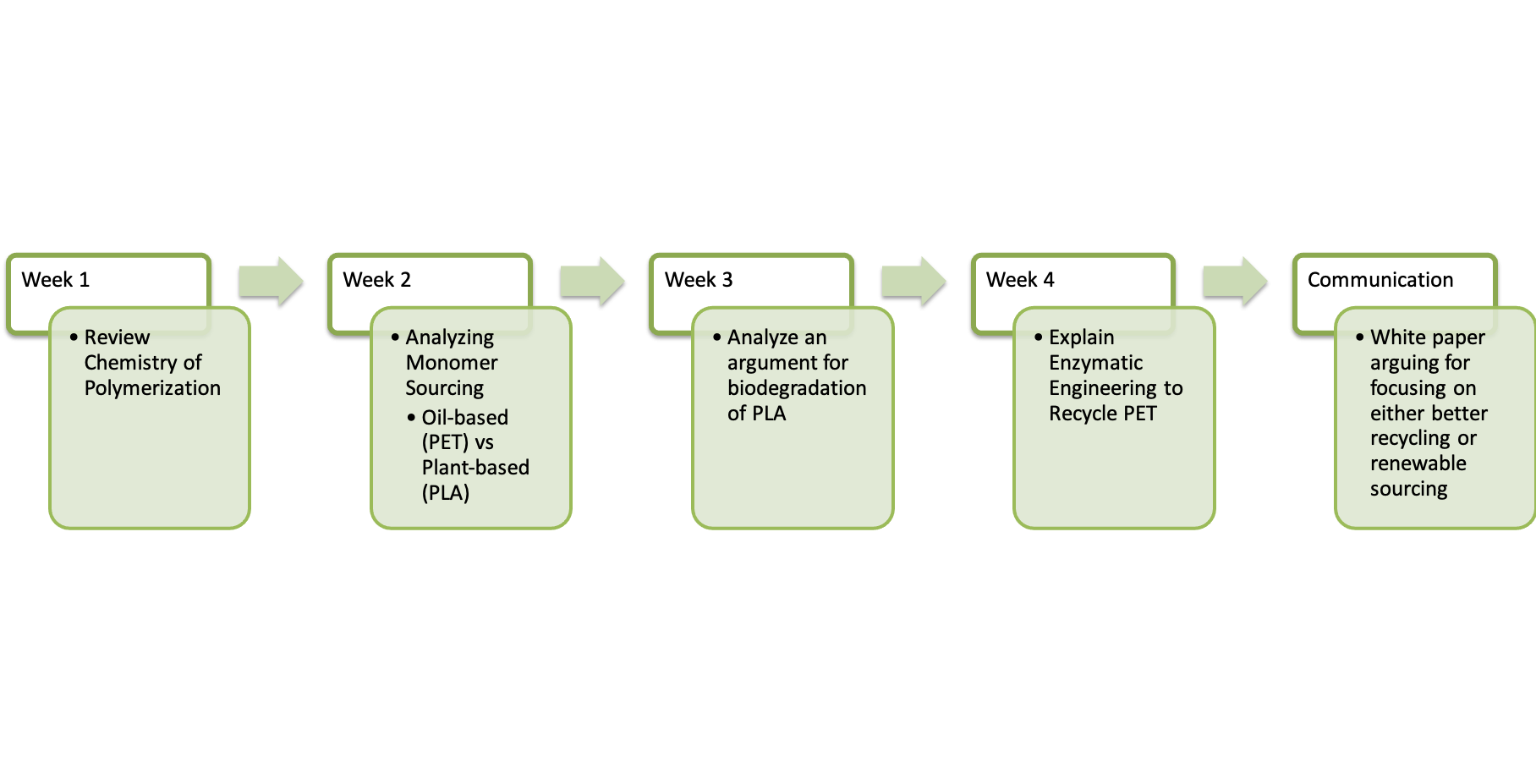
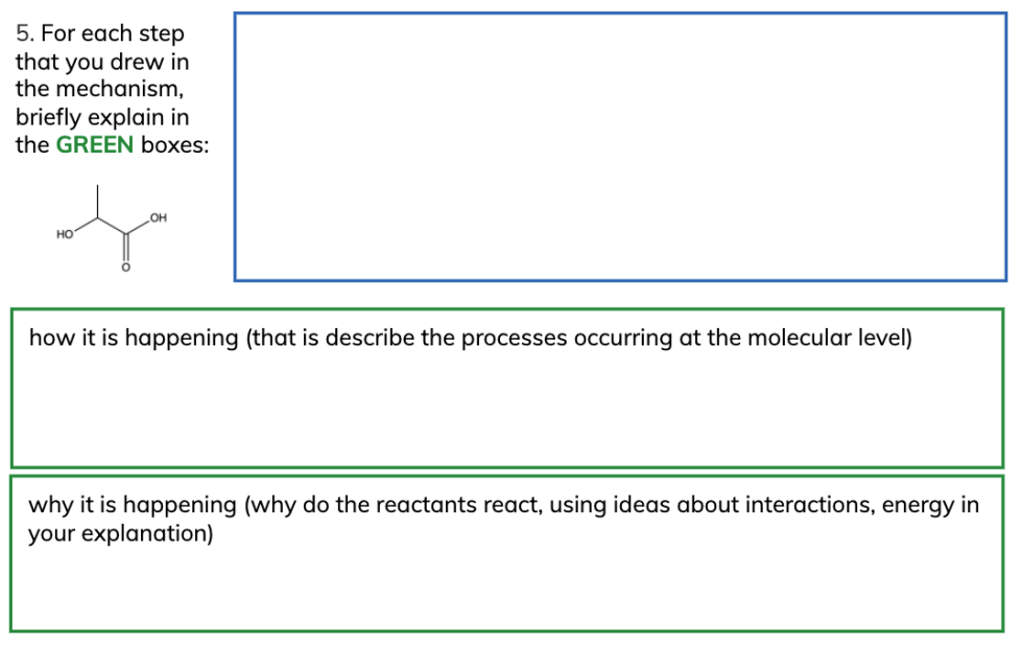
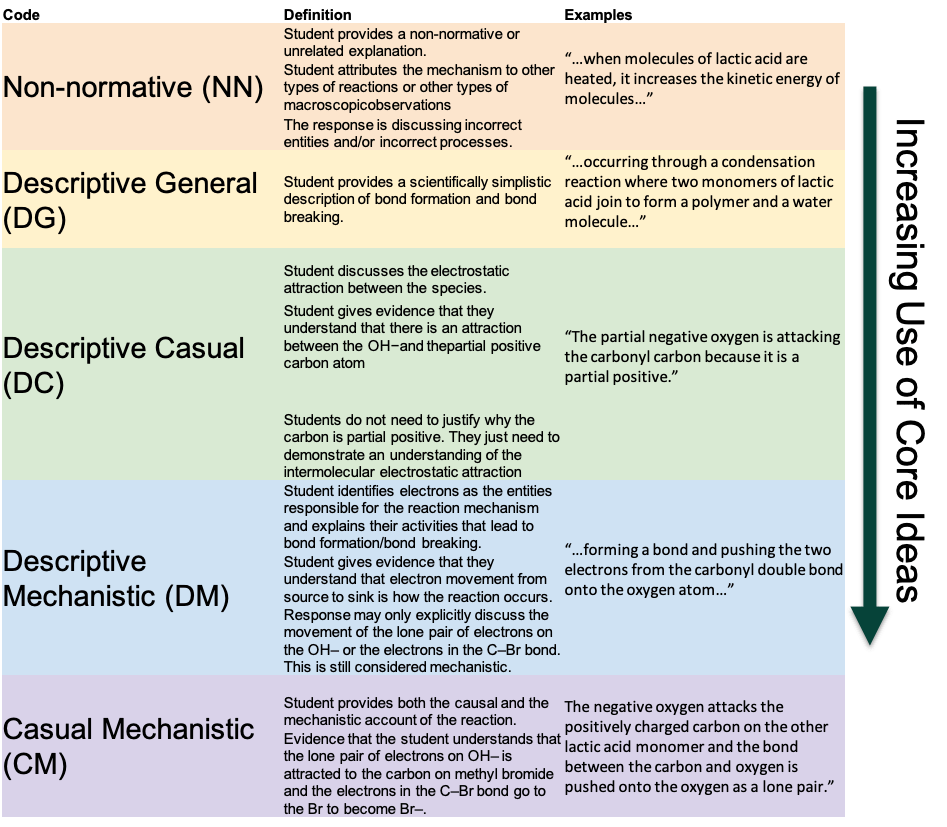
Case Study 2 (CS2) focused on a life-cycle analysis of polymers used in single-use plastic drink containers, the timeline of which can be found in figure 1. In week one (CS2W1) students were reintroduced to the chemistry of polymerization, a topic that they would have covered in the prerequisite course Organic Chemistry I (CEM251). In one prompt students were asked to predict the mechanism of polymerization. In the following prompt (figure 2) students were asked to explain what was happening and why it happens. Student responses were coded using a codebook for mechanistic reasoning (figure 3) adapted from3.
In week 2 (CS2W2) students explored the sourcing of monomers for synthesis of the polymers. Included in the activity was the question, “Are there other factors about the monomer sourcing to consider? Such as are we using a resource that could feed, shelter, or provide energy for homes? If so, how does that affect the UNESCO Sustainable Development Goals?” Student responses were analyzed for how many UNESCO Sustainable Development Goals (UNSDGs) were mentioned and the frequency of each was mentioned.
Results and Discussion
Objective 1: Describe the ability of students to explain mechanisms through core chemical ideas
To measure student’s core chemical knowledge we coded their mechanistic reasoning. We chose this question as it allowed us to examine the students ability to apply chemistry core ideas (electrostatic and bonding interactions and atomic/molecular structure and properties) to the relevant chemistry (condensation polymerizations) through the scientific practice of constructing an explanation of how the reaction occurs.
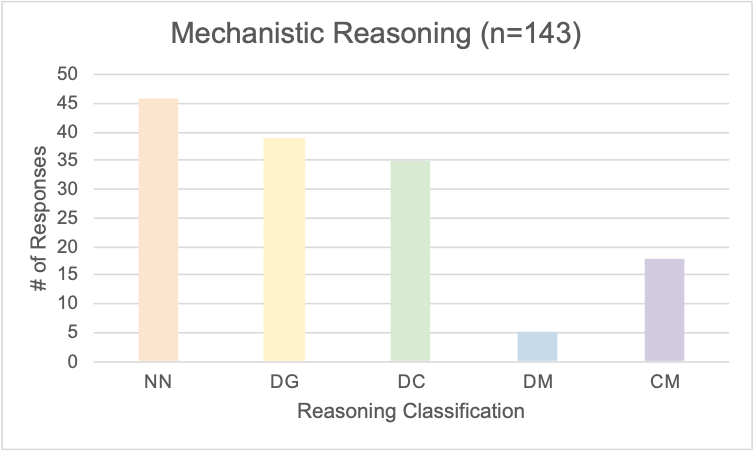
Coding of student responses (figure 4) revealed that most groups tended towards non-normative (NN), descriptive general (DG), and descriptive causal (DC) explanations. Interestingly there were very few descriptive mechanistic (DM) explanations. The prevalence of overly simplistic explanations and lack of DM explanations suggests that there is a problem with our prompt.
Versions of this codebook (figure 3) have been used to code acid-base and nucleophilic substitution reactions3,4. These studies focused on highly similar student populations (students enrolled in co- or pre-requisite courses) to the student population in this study. In both studies the frequency of student responses were as follows NN<DG<DC~DM<CM. Since similar students have repeatedly been found to be able to explain their reaction mechanisms using chemistry core ideas this supports the idea that there is a problem with our prompt.
The likely culprit is the length of the mechanism groups were tasked with explaining. The previous studies focused on one to two step mechanisms3-5. The mechanism in this study is composed of ~10 steps. To include the detailed explanation required for a CM answer would require most of the class time dedicated to CS2W1’s activities. To save time, to answer the other questions in the activity, groups likely defaulted to more simplistic explanations. This is further supported by the lack of DM explanations. For a DM explanation students would have to describe the movement of electrons in each step. Each step contains at least one pair of electrons moving and many contain multiple electron pairs moving. The amount of electron movement quickly becomes more than we can expect groups to explain as only a small part of a larger activity.
Objective 2: Quantify the frequency students articulate repercussions or conflict between U.N Sustainable Development Goals (SDGs) of the solution.
Part of the goal of the larger curriculum design project is exploring how students knowledge of core chemistry ideas to propose or evaluate solutions to complex real world problems. Our framing of green and sustainable chemistry in education is that it is a way of framing decisions. That includes analyzing unintended or knock-on effects of proposed solutions. The UNSDGs can be used as a simplified analysis of knock-on effects. We asked students to identify which SDGs would be effected by use of each plastic under consideration.
Our first analysis was to quantify the number of times each SDG was referenced (Figure 5). Based on the based on the content of CS2 we were expecting SDGs # 2, 11, & 12 appear in student answers the most. For example SDG 2 (Zero Hunger) would be expected to be negatively impacted by the use of a plant-based polymer (PLA). Farmland used to grow crops for plastic cannot be used to grow foodstuffs. As expected SDG 2 was the most commonly mentioned UNSDG.
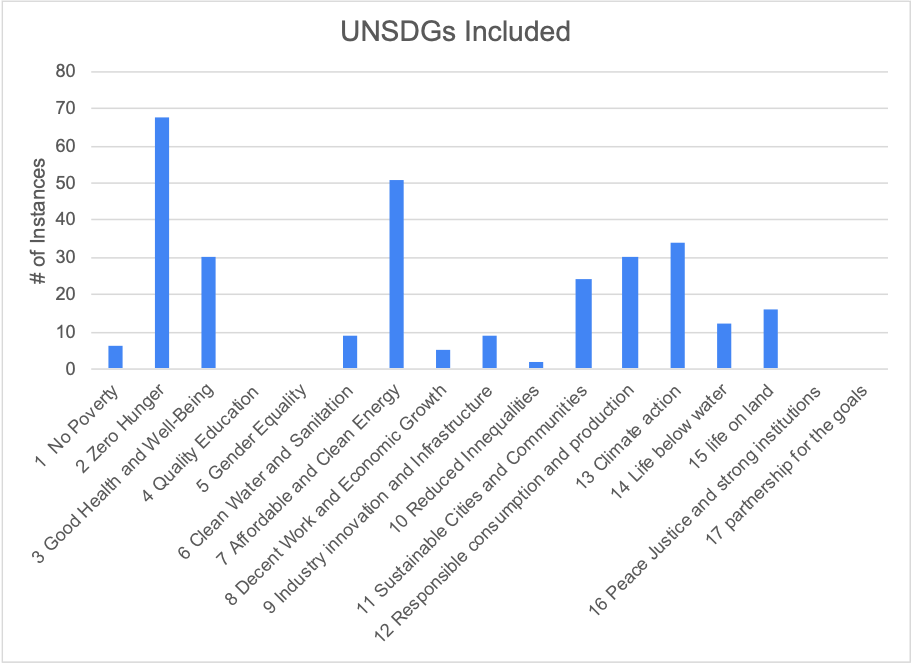
The second most popular UNSDG invoked was #7 Affordable and Clean Energy. Groups who brought up SDG 7 commonly brought up that using oil for plastic production (PET) would decrease the availability of oil for for energy production and drive up the price. This is anecdotal evidence that students are bringing their real-life experiences into the classroom. The CS2W2 activity was administered right as the price of gas spiked due to the war in Ukraine. It will be interesting to observe if the frequency of SDG 7 will change in subsequent administrations of CS2.
Objective 3: Evaluate the relationship between mechanistic explanations and students’ incorporation of knock-on effects.
We were able to track group responses over the course of CS2. The averaged number of UNSDGs mentioned by each mechanistic reasoning classification was calculated (figure 6). Our hypothesis was that groups who had a better understanding of the underlying chemistry, evidenced by CM reasoning, would interact more with potential knock-on effects, evidenced by the number of UNSDGs mentioned. Unfortunately we observed no trends between the quality of mechanistic reasoning and the number of UNSDGs mentioned. This does not rule out our original hypothesis but is likely due to problems in our assessment instruments. As discussed in objective 1, we probably asked the groups to describe too much as the distribution of mechanistic reasoning does not match the distribution from previous studies on similar populations using the same codebook.
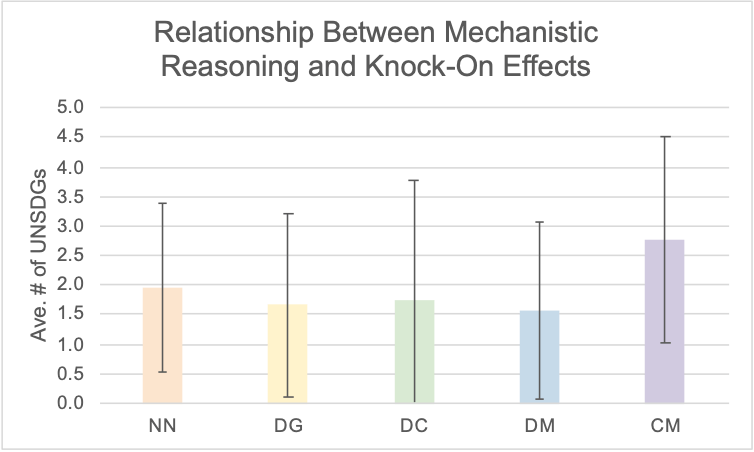
Additionally, measuring the number of UNSDGs mentioned by groups is not the best measurement of the understanding of knock-on effects. This is evidenced by the large standard deviations in each group (figure 6). Across all groups there was a spread in how groups approached the problem. Some groups listed UNSDGs without explanation, others predicted the effect each solution would have on individual UNSDGs, while the rest took a hybrid approach. These distinct groups suggest that a better analysis method would be the development of a codebook analyzing whether a group strictly identifies an UNSDG, identifies and makes a prediction of the effect on an UNSDG, or identifies, makes a prediction and explain the solutions connection to the prediction.
Conclusions:
Curriculum development and chemical education research is an iterative process and this work is no different. Just as we revised our prompts following cognitive interviews with students (not discussed here), the data gathered from this first large scale implementation will inform the revision of our case studies. The mechanistic reasoning prompt will be redesigned so that groups will only provide explanations of only one or two steps of the larger mechanism. As for analyzing groups’ incorporation of knock-on effects in evaluating solutions we plan on developing a new codebook to analyze the complexity of groups’ interaction with knock-on effects and redesigning the UNSDG prompt to align with the new codebook.
References:
- Juntunen, M. K., Aksela, M. K. Chem. Educ. Res. Pract., 2014, 15, 639-649
- Bryfczynski, S., Pargas, R., Cooper, M., Klymkowsky, M., Hester, J., Grove, N. (2015). Classroom Uses for BeSocratic. In: Hammond, T., Valentine, S., Adler, A., Payton, M. (eds) The Impact of Pen and Touch Technology on Education. Human–Computer Interaction Series. Springer, Cham.
- Crandell, O. M., Lockhart, M. A., Cooper, M. M. J. Chem. Educ. 2020, 97, 313-327
- Cooper, M. M., Kouyoumdjian, H., Underwood, S. M. J. Chem. Educ. 2016, 93, 1703-1712.
- Crandell, O. M. Investigation of students’ causal mechanistic reasoning in undergraduate organic chemistry. East Lansing, MI: ProQuest Dissertations Publishing: Michigan State University; 2020.
 Hunter McFall-Boegeman